BTG 101 - A Crisis of Faith
August 26, 2024 · 29:30
Listen
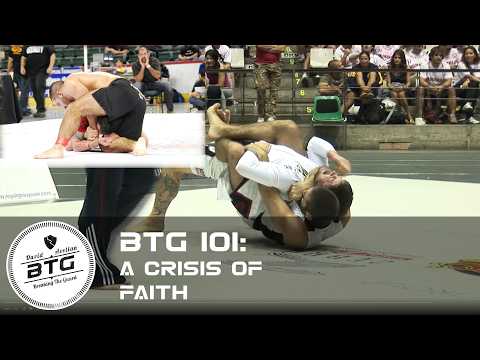
Some of you wrote me to tell me you enjoyed my stories I told in the Chewjitsu Podcast Interview I had a few weeks ago, so I decided to share one that is very important to me - my crisis with faith. I'm not talking spiritually here, rather, personally - as I had a moment of weakness that cost my the chance at a world title. I share the lessons I learned and how being delusional can be a good thing.
Listen & subscribe
Transcript
Auto-generated from the YouTube captions — may contain errors.
Hello and welcome to breaking the guard. On today's episode, I'm going to go through a personal anecdote of mine which I've told in a lot of seminars as I had a couple viewers write me asking me to share some more stories. uh they listened to the the podcast that I have with Chewy, which is in the blog. If you haven't seen it yet, you can check that out. It's actually a 2hour long interview. Uh so, and a lot of you guys seem to enjoy that those stories. So, I'll share one of those in case you didn't tune into that. And this is what I call the crisis of faith, a Kimora trap story. Right now, where does this start? It was 200780cc. I was in the quarterfinals facing Tarsus Humphre. This was my first meeting with him. I didn't really know anything about him and we got into a match and I felt like I dominated most of the match from the the regulation to the first overtime. When we got into the second overtime, not a lot happened and then he had shot a single leg and had me on my knees basically defending. Now, I had a Kimora locked up at the time. My confidence level with the Kimora Trap system at that time was very low. I didn't I don't think I even had the name Kimora Trap labeled quite yet. Right? So, like that's how early we're we're in. Right? I am just tinkering at this point. It's like the beginning of my journey. Uh now I made a calculation whereas I look we're in double overtime and the only thing of significance that happened he shot a single leg and I'm defending it. If the match ends like this I thought I was going to lose because I'm like I didn't do anything offensive. He made an aggressive motion. Now, my confidence faltered there because I'm like, I don't know if I want to try this Kimura and to drop into it and go into the TB position and start looking for attacks. I wasn't confident because this was going to be my first time using it in competition, let alone in the World Championships, right? So, I made the gut call. I'm like, you know what? Abandon this and go into a regular shot defense, right? uh just to try to stuff the head and all that. The moment I abandoned that, he instantly jumped to my back, locked in a rear naked choke, and the last thoughts that I had was, "How am I going to get the points back?" Because he had gotten the hooks in. Moments later, I woke up. I was looking at the ceiling and I realized, "Ah, damn it. I got choked unconscious, right? So, I didn't have much much time. It was pretty fast. At least in you know, it's kind of hard when you go unconscious because the time dilation and all that. But at that moment, I realized, man, I goofed, right? I should have held on to the Kimua. The referee even told me, "If you would have just held on, you would have won the match because ABCC judges the whole of the match and not just the overtime." Which begs a question, why did I need a second overtime? I don't know. But in any case, um it was clear I made the wrong decision. And I made the wrong decision because of lack of confidence. I didn't have faith in my ability to finish that kima. And this is a realization that came to me over time as I started really working on the Kimora trap system more. And the way that I built up confidence was that whenever I went to train, the only technique I allowed myself to do was the kimora. And initially I started the idea of using kimoras was very simple as far as you remember when I when I say kimora trap just to be very clear because a lot of people say call anything that's a kimora a kimora trap and that's not necessarily what it means at least as the guy who created the term I think I have the right to say what it is. The kimora trap is when you use the kimora as a grip instead of as a submission. Okay. So when someone shoots the head inside single leg and I lock on a kimora when I use that to do like a sumih that's a kimora trap right because the trap being you think that the submission threat is coming in and you're defending the submission threat leaving you exposed to a sweep threat a takedown threat a guard pass threat or another submission threat u so my initial concept the kimora trap was very simple kimura to the back mount kimura to armbar and that was my starting point right and I actually had picked these up uh when I trained with Rodrigo Dam in St. Petersburg Russia again so this is going earlier in 2006 December or I think early December late November we went to St. Spiritburg. I was coaching Whitet Massfit all the time and I was hurt so I couldn't actually train with him. And Rodrigo was the same weight class and they weren't fighting each other so they made good partners. And I saw Rodrigo, he's a submission wizard, really good jiu-jitsu guy and he was tapping everybody in the training room, but uh in particular he seemed to really utilize Kimora armbar, Kimura back take. Like those were like his bread and butter moves it seemed. And uh I ended up bumping into him one more time when I fought in Bodog in Costa Rica season four around I think that was March, April. And uh I got to train with him and uh and learn those moves from him. And that was the starting point and that inspired me because I saw how effective those transitions were. And when I started training with George at the time when he was still at at our gym, we were just drilling back. And then the way I always like to learn is through specialization. So I started forcing myself only to use kimoros every time I trained. And I was getting a lot of success from those. Uh but I also started figuring out new ways of using it, right? Like I started saying, hey, you know what? Like I can do this kimora from not just from a single leg. I could also do it from a double leg. I could do it from a high crotch. I could do it from a body lock. I can do it from turtle. I could do it from both the top or the bottom of turtle positions. Uh and it it started making a lot of sense. I'm like, you know what? This is starting to become more than just a little trick. This is a system, right? like there's something everywhere that allows you to do kimoras. And this was also inspired by like my engineering background and mindset. I made flowcharts and I actually compared all the different submissions and where you could hit them from. You know, the top two was Kimura and Armbar, right? And they're kind of related in the sense because you could do them from each other. So, it makes sense. They're both highly versatile. the to my my opinion the most highly versatile submissions in the game. So if I was going to specialize in something it would be an armbar or kimora and I just happened to be more of a kimura guy. So um I I leaned on kimura and as months went by I noticed that lots of my training partners and students would complain that all I did was kimoras but what they didn't say was that it was always working. So, I knew I was on to something because when people complain about something that works, it means that they don't know how to stop it or they can't stop it, which is great news for me. Uh, around that point, we started, I think maybe later in that year, I came up with the term Kimora Trap and I didn't release a system until 2012. So, it was still like an in-house secret because I remember at the time I was thinking like this is like some super special knowledge I developed because what started with just like a couple tricks became, you know, there's probably a hund different situations you can use it from that off the top of my head at least. So it it became a whole game. Like I could just use Kimura and have a very complete game from top, bottom, half guard, you know, side control, back mount. Like it's everywhere. So I then got to compete in a local grappling tournament. It was a grapples quest. Actually had, you know, couple of like black belts in there. And I just that was like my Kimmor trap system debut and I dominated very easy and was able to utilize it in all my matches. So my confidence levels only built up and uh sure enough I go into or even before that I will say that I wanted to make a promise to myself and I did which is that if I ever locked down a kimora I was never going to let go of it. I was going to hang on to it until the very bitter end. And I know some of you are thinking, well, what happens when you hold on to the kimora armbar? That's like one exception, right? Uh if you held on to the kimora and you allowed them to walk all the way around, which is a mistake in itself, but if that happened, of course, it's a good time to let go. But short of that, you're holding on. And I use a lot of positive affirmations. I have a journal that I write in and I would talk about my strength, my confidence, my faith, and my submission ability. And I just noticed that in the training room, my finishing percentage just skyrocketed. Whereas before I, you know, scored a lot, I would get a lot of guard passes and takedowns and mounds, now I was getting lots of taps. So that training room confidence translated. When I went to compete in ADCC in 2009, I submitted I got my first submission in ACC, which it wasn't a Kimora, it was a Hill Hook, but submission nonetheless. My second match was a rematch in the quarterfinals with Tarsus Humphre. And we got into a very similar position. Low single shot he took. I sprawled, got into a Kimura. This time around, I was confident and I locked myself in. We got into some funky spots because it didn't seem like he was very well verssed in that position and he made some weird uh movements. Not typical. So, we went out of bounds. They restarted us and then he started trying to work out of it and um eventually I forced a mistake because I had the TV position on him kind of like a back crucifix and I did a mouth smother and during the smother he bridged and turned into me which was the moment that I was waiting for was able to sink to the back get to that one- arm choke and execute that finish which uh was amazing for me because I think that might have been one of the first one- arm chokes in jiu-jitsu history. And uh I say that because I had Bali Osteo, bunch of people come up and they kept commenting, "Oh, you got like strong biceps." And I'm like, "No, dude. Like I got like even though I'm working out a lot now, like my biceps have never been big, right? Uh they don't really really pop. It was technique." But to a lot of people, they thought I just like bicep curled on his neck to make him tap. And they didn't realize like the mechanics of a one- arm choke, which is kind of more like a lapel choke in a way where we're using the blade of the forearm to cut through the throat. Uh, so that was really cool for me. And I ended up getting another Kimora trap on Galva, but unfortunately I ran out of time and I had to try to score. I had to abandon it with like 15 seconds left. and try to get a taked down. I ended up losing that one two zero and then I submitted Lovato in the consolation finals to take third. So it was uh from going my past two ADCC's with zero submissions to going to three out of four matches with submissions and one of them with two near submissions. Something changed big. My technical level had raised up significantly with Kimoras in particular, but more than anything else, my confidence had skyrocketed with submission ability where I now had faith in myself that I could finish people with ease and especially when I got into my strong positions which were kimoras. That is the biggest takeaway for me from that event and it's what I tell people in every seminar. Doesn't matter what your submission is. If it's leglocks or it's chokes or you know kimoros, you have to have more faith in your ability to finish than your opponent has in faith to escape it. Because when we're doing a submission hold, it's a battle of wills. One person is trying to survive and one person is trying to kill. Right? If you don't think you have the ability to kill that guy, you're going to tap out by letting go of your submission before you give them the chance to tap out. It's a choice on both sides to submit. Right? So, what I'm telling you is don't tap yourself out. If I'm going for an arm bar, go for broke. Have faith in your ability to finish. If you are worried that you're gonna lose it, chances are you are. If you think your submission is weak, it probably is. You need to have faith in it. Think of guys, and I always say the name same names. When Dean Listister gets in on a leg lock, he's not second guessing himself. When Marcelo Garcia gets a guillotine or or any joke really, he's not second guessing himself. He knows he's going to finish, right? You have to have that same belief in yourself that when you get a submission hold, it's on because not only is it going to make you finish better, there's an aura about somebody who's very confident and especially when it comes to submissions that gets transferred like the opponent can read it. And when they know someone is ripping an arm and that guy has full faith in it, they tend to tap faster. I say this because I have never heard anyone in in competition and very rarely in training. I I I can only think of one and it was a guy that was being really stupid. I had him in a a knee a knee compression. Uh actually the same type that uh Kanye Dwarte did uh not Kanye Dwarte, I'm sorry. Um Lucas Barbosa did to Joseph Chen. same type just from butterfly guard sliding the the arm under and then sitting on it trapping it. And I remember this guy was wearing a knee brace and I was looking him dead in the eyes and I'm like hey are you okay? He's like yeah. I would scoot in a little bit. You still okay? Yeah. I'm like hey man it's getting really tight, dude. He's like yeah I'm fine. I'm like man be careful. He's like I'm okay. And then the last scoot I heard his knee just go and I was like what the hell, man. And like I was mad because it was so slow. It was kind of like that Austin Powers when they had that flattening machine coming and the guy's like, "No, he's not moving out of the way." It's like, "Dude, you had like 30 minutes to get out of the way." You know, like this guy had so much time to tap and he never tapped. I still don't know why he didn't do it. And it was a hurt knee because he had he was wearing a knee brace. That's besides the point. But what I'm saying is I feel that when I apply submissions, not only do I apply them controlled, but I'm going smoothly into the finish. And uh in competition, I've gotten lots of really early taps where people tap before the threats even fully realized. And I believe in part is because of confidence of execution, right? When you're very confident in your ability, people can detect it and they know like I'm not going to get a second chance. like if the window to tap is right now or I'm going to get be hurt. So I feel that it's going to definitely make your job easier as a finisher and that's what we want to be ultimately. I don't want to create people who are like points players. Why? While that might be good in sport, it's not good in real life. And ultimately real life is more important to me, right? I do love sport. It was what fueled my passion for being invested in becoming a martial artist. Truly, it is a game. Whereas in real life, a self-defense scenario is everything, right? Protecting somebody from danger is everything. Nothing more important than that. So, if you're playing for points and you're playing for special rule sets, you're not playing for real. You're playing a game. And it it's a good game and it translates to in aspects to real life. But let's play real. In real life, we need to be able to finish, right? Or have the intent. It's just like if you're uh training to use uh a firearm or a knife, right? If you don't have intent to actually use it, you're you're not going to be able to shoot when the time comes, right? You're going to second guess yourself. You're going to hesitate. You have to be able to execute. And that only comes to training and developing confidence and believing in yourself. Right? So when you train, you need to have that stubborn belief in yourself to the point of delusion. Right? I get called delusional by my wife all the time and she's a psychiatrist, so she might know it better than anyone else. But I have a stubborn almost delusional belief in my abilities. And I believe that's fine. I believe that's necessary. You talk to anybody who considered it great, they seem delusional to the person who doesn't really know them, right? When you hear about uh Gordon Ryan talking about how he's won everything and he's the best ever. To some people, he's arrogant, delusional. No, this is what a champion has to say. The goals and dreams that they have are so big that it has to sound silly to the average person. If it doesn't, something's wrong. When Nicholas Margali is talking about, oh, I'm going to double gold this, double gold that, to everybody that's not in his circle, they're like, man, this kid's full of himself. He's like, he has to be saying that. If he's not, something's wrong. Now, in his case, it didn't work out this time around. And all the haters will be, you see, you didn't know what you're talking about. Yeah. And that happens, right? You can't let that sway you, right? You made mistakes. I'll come back and I'll have everybody saying I'm crazy again. You need to be able to be at that level if you want to be a top performer. You have to be comfortable with people saying you're delusional. If you're not, like I said, maybe you're not dreaming big enough. Maybe you're leaving something on the plate. If your dreams seem so realistic to everyone else, especially to the normies, you might be thinking, man, am I setting the bar too low here? Because when you dream big, it should sound crazy. It shouldn't be normal because you are doing something normal. You're doing something above and beyond what everyone else thinks is even possible. And only when you go out and prove it time and time again, well then maybe people start saying, "Hey, he might be right. Maybe he is on to something." When Muhammad Ali was out there talking all the smack of the world, most of the people were hating on him, you know. But after his record of proving that he was winning all these big fights, people started saying, "Hey, you know what? Maybe he is the greatest of all time." All right. when he but he was saying it from the beginning and a lot of people are saying oh that's great marketing which it is right draws a lot of attention it does uh and he's also crazy probably but these are all things you need to achieve greatness and that only comes from belief in yourself so if you are listening to this and you're like David I do want to have killer instinct I want to have that faith I don't want have that situation that you had of a crisis and lose a match in the world championships because you didn't believe in yourself. But how can I believe in myself because like I'm not that good. You know, you're a black belt, whatever. I'm just a blue bell, but I do want to have that faith, but I just don't think it's realistic. It's not supposed to be realistic, right? Get that out of your mind. Believe in yourself first before anything else. Because while you might not be there right now in this present moment of time, we must believe that we will be there eventually. And this perception of time is just a perception in my opinion. Everything has already happened that will ever happen. We're seeing it happen in slow motion. So I want to believe that at some point in time I will be that great. And if it's going to be true, that means it's true at this point. And I better start acting like it because the the way you think, the way you believe in yourself, your and your level of confidence is going to affect your outcome tremendously. This is why conscripted soldiers don't do as good as well as those that volunteered. you know, the the Merdans or the the the oldtime uh mercenaries, they didn't fight as hard as the guys that were fighting to defend their country because survival is much more important than money, right? Your your your motivation is greatly different, right? So confidence is obviously key and we need to have that and that comes with faith, you know? So start in believing yourself and like I said if it's delusional that's a good start right like you should be a little delusional and train to match that ability if you're very far from it that means you need to train more and you'll build confidence over time and initially when you start this journey you're probably going to be low confidence low skill so the delusion will seem very high unproportionately ely high. But as you build more skill, you'll probably develop more confidence as your skill gains results. And the more results you get, the more confidence you get. And then the more confidence you get, the level of delusion will seem lower to you, right? It doesn't matter what anybody else thinks. Get that out of your mind. You're never going to make the masses happy. Doesn't matter. You just have to get it in your head. At some point, you'll stop feeling like an impostor and it's going to be kind of one of those fake it till you make it situations, right? And at some point, you'll say, "You know what? This is happening. This is real. I am that confident. I know I can finish people now." And when you get there, it won't matter what everyone else thinks because you already know it. And then you'll get to start proving it to everybody else, right? But the confidence is everything. Without confidence, you're a broken man. You're going to have a hard time pulling anything off. You'll have all the potential of the world, but none of the follow through. When the going gets tough, you get going. Right? So, you have to be locked in. The tools that I've given you here is one lots of training, positive affirmations, journals, write things down, right? Like all these things help cement this idea, this belief that you're going to instill. It's a choice. You can choose to believe or not to believe. I would say, why wouldn't I want to believe in myself? What's it's it's not uh you'll prove it, right? It doesn't have to be right now, right? So, don't worry about if you're measuring short right now. We're going to be working on this goal for the rest of our lives if we have to, right? Just believe that you'll get there and do the right things. Like I said, training, lots of exposure to situations, do lots of situational drills. And have you guys seen I've covered all I've covered this topic quite a few times over the over the years. And uh I do have drilling session. I just did one not too long ago about drilling a situational drilling which would be very useful if you're trying to build up confidence in a particular skill set. Right? And by doing that you're going to make yourself much more confident, much more effective and in a much better mental state. I hope this uh topic helps you out. Again, it's something that's personal to me because I got to feel this transformation and it was life-changing in many ways. And uh I always want people to do better than me. So, I want to share my shortcomings and then how I overcame them so that you guys can get there faster than I can. That's the ultimate goal of anybody who is teaching in my opinion that the students surpass them. So, thank you guys and uh I'll see you all next